

A new book about the vulnerability reveals what happens inside the coach and the coaching. Nine experienced coaches each demonstrate how deep insights and personal change can be produced just by observing their own nakedness.
The Naked Coach is a book about vulnerability in the helping professions, written by experienced practitioners who were sincere, true, and honest with themselves and allowed their practice experience to work on their hidden, stuck, and even shameful challenges. The result is a series of revealing personal narratives conveying what it means to be a ‘helper’, at a deep level.
All chapters have been written by executive coaches, i.e., those who help leaders in organisations by means of a contracted series of reflective conversations. The form of help that coaching offers is not so much helping ‘overtly’; it is not doing something for the client, not task-based or expert-based. Instead, similar to psychotherapists and organisation-development consultants, coaches open up and hold a space in which clients can help themselves. In other words, coaches facilitate a transformation or development from within the client, where the client becomes able to arrive at new meaning and perspectives, can approach things differently, or resolves to take important decisions.
This means the coach is mainly partnering with the client, spending time together, and listening, summarising, exploring the client and their challenges. The client can be an individual or a team that has a common mission. The coach does not need to take responsibility for the client’s goals, neither do they contribute deliverables or solutions. Coaches are not responsible for any outcomes, be they positive change, such as achieving key outcomes, or continued struggles for the client. This helping role is more like a witnessing, caring or nurturing role, a role familiar to us all from many areas of our lives. Research has shown that coaching relationships are effective, with the degree of effectiveness being moderate to high (De Haan, 2021).
The writers of The Naked Coach have each had an extensive career behind them and are re-evaluating themselves in their helping roles. Each of these authors investigates areas of personal vulnerability with courageous dedication, until fresh insight or a new resolve emerges. This affords the reader a rich appreciation of what happens inside the coach and the coaching. The authors apply the ‘change from within’ coaching principle to themselves, regarding their own challenge or vulnerability, supported by an academic tutor, by their supervisor, and often also by a therapist. In other words, there is a parallel between their own research and the kind of help they are themselves providing to their clients. Coaching affects the coach as much as the client. Looking into how we are affected can make us a better coach, as each of the chapters shows.
Vulnerability may be the difference that makes the difference
We are only at the early beginnings of understanding what makes coaching effective. From the latest quantitative research findings we may conclude that coaching in many forms and settings is overall an effective intervention that tends to make a difference that is noticeable (De Haan, 2021), but we do not know very much about what it is that makes coaching so effective. There are some indications that it is not so much the techniques or skills of the coach but instead much more the ability to stay with the client and explore the coaching relationship and themes.
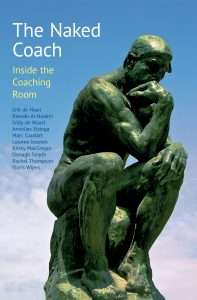 Erik de Haan, Eddy de Waart: The Naked Coach: Inside the Coaching Room, Libri Publishing Ltd, November 2026,192 Seiten, 32,50 Euro
Effectiveness seems to be much more about the partnership itself, about being fully present and aware of the unfolding relationship, rather than about the specific actions, skills, interventions, or ideologies within the coach–client partnership. This is sometimes called the ability of coach and client to ‘co-regulate’, to move in tune with one another, and to negotiate successfully the different stages and contributions of coaching such as goalsetting, exploration, empathy, challenge, and review.
We can see additional evidence for partnership and regulation from the research into AI and coaching. A few randomised controlled trials have been done (Terblanche et al., 2022; De Haan et al., 2026) which show that the effectiveness of the AI chatbot is limited as compared to the human coach. AI’s effectiveness is mostly confined to monitoring specific goals. Human coaching, where there is a more equal partnership, including bonding and co-regulation, seems a lot more effective. This difference in helpfulness of the human versus the AI coach has little to do with the difference in interface or pre-existing low expectations regarding AI (Barger, 2025). This book demonstrates, if it was needed, the truly vulnerable nature of human coaches. It shows the deep emotions that can emerge for the coach and how these can be used in service of the partnership. It may even be that coaches are most effective when they embrace their own vulnerability – for example, when they struggle to follow their clients, feel uncertain about what to contribute, or try to resist the urge to take over and offer solutions.
Some examples of coach vulnerabilities
Here is an example from one of the chapters: “I began to notice how much pressure I placed on myself to help, solve, and steer. I was becoming increasingly identified with being effective because I was good at fixing and solving problems.” Like in other professions, the pressure to perform makes us vulnerable. However, in coaching this pressure is different and possibly higher, as we cannot really ‘perform’ in the usual sense. After all, outcomes are entirely decided, authored, and achieved by the client. So, feeling responsible for an outcome that the coach cannot really influence can make our vulnerability worse, as several chapters of The Naked Coach demonstrate.
An added challenge is that we do not even know what ‘performance’ really means here. Quite often the coach or even clients themselves do not understand their needs fully. And when it comes to contributing to the conversation, coaches have so many good options that they are often spoiled for choice and may struggle to grasp the nettle on the spur of the moment. Coaches are therefore often uncertain about what to say or do which makes them doubt whether they are of any help.
Deeper patterns underpinning the vulnerabilities
The authors in this book become aware of deeper pressures to help others, which actually contribute to them being less present or less flexible as coaches. Those pressures often stem from unconscious motivations for this ‘helping career’, such as having to help in the family at a very young age (‘parentification’), or as a well-worn defence against helping oneself (avoiding being helped by helping others; pro-social pathologies). Upon entering the helping professions this so-called ‘helper’s syndrome’ may be satisfied to an extent, but it also gets exposed and challenged.
The same frustrations as we experienced in the family, where ultimately, as a young child, we could not make much of a difference through helping conversations, will be surfaced. At the heart of being a helper, we are wrestling with our own histories. As several authors in The Naked Coach have noticed, this makes us less present and available with the current conversation and with our clients, however much we want to be. We learn that we need to be at ease with ourselves, open, and fully present, just to be really trustworthy, containing, and ready to work with our momentary felt sense.
At the Ashridge Center for Coaching we invite all our participants on the Executive Coaching Master’s programme to undertake action research in their final year, in the sense that the research for their dissertation needs to be undertaken in a rigorous and highly introspective way. We believe action research is a particularly helpful research method when exploring personal change and development in real time. Often, we see that an action researcher who has lived with her own challenges and vulnerabilities for the best part of a year becomes noticeably more open and accessible.
Researching your own vulnerability through action research
All of the coaches who wrote a chapter in this book have engaged in action research and produced a top dissertation with high-distinction grading. Their chapter is ultimately based on a successful piece of (action) research, which has transformed them and their coaching practice.
By studying a well-chosen challenge (or ‘inquiry question’) over a sustained period of at least eight months, subtle shifts are bound to happen, either in the understanding of the challenge, the nature of the challenge, or the ability to rise up and face or overcome the challenge. This sustained process can transform an individual and make a lasting impression, especially if it is supported by others who help by noticing signs of change and (internal) obstacles to change.
In this book the challenge was always a coaching challenge, so the authors have always changed as a coach but consequently also as a person.
How does this type of research work? Essentially, the participant orchestrates ‘cycles of focused attention’: attending to or meditating on the challenge and bringing curiosity to new experience as a result of the deliberate focus. So, the researcher studies the challenge and how it plays out in current experience, by studying the experience itself. In this case, the focus is particularly high during coaching conversations, but any other experience during the period of action research can be taken in and can yield fresh data. How is it relevant for my challenge?
How does it provide a different perspective, an answer, a new, related challenge, or anything else that might be relevant? It is a very open form of researching that oscillates back and forth between challenge (inquiry question), new experience, and how I as a researcher–coach am affected by both.
Initially, what the sustained attention may deliver is unknown as the future of personal transformation is uncertain and unpredictable. This often provokes a new anxiety within the researcher, on top of the anxiety related to the challenge. The participant does not know if action research works, and if it does, when it might work, and with what potential outcomes.
The research process can be quite stressful due to all of these unknowns. This is where tutoring, supervision, and personal therapy can help. Yet even successful change can become confusing and deceptive, as we will often see that the challenge and the new insights go far beyond only coaching and manifest in different spheres of the researcher’s life.
The daunting and open-ended nature of this type of research becomes more manageable – and only apparently predictable – when the tutor and the action-research literature provide assistance towards making a research plan that includes a methodology.
With a methodology, the unknown, long process can be divided into smaller elements, with manageable steps, and a number of action-research cycles (oscillations). The researcher starts planning different forms of sustained attention (inner arc, outer arc, first person, second person, third person, etc.).
None of these are essential to the project, yet they do reduce anxiety especially for the beginning researcher. We can now see the process unfold in various steps (cycles) and distinct reflections (such as outside-in versus inside-out or through the eyes of self, another person, or an outsider). But these are only lenses – a map, not the territory. For a more in-depth appreciation of action research, see the prologue of De Haan and colleagues (2016), another selection of outstanding coach dissertations.
As a common thread between all the chapters, we see each of the coaches become more vulnerable and more open, more of a ‘naked’ coach, at least to themselves. The authors cleansed themselves, allowing their experiences to work on them, and came out refreshed and renewed.
All of the coaches would agree that now, years later, they are still travelling with their challenge, in some form, and they are still benefiting from the (beginnings of) transformation that this dissertation research process ushered in.
A great action-research inquiry benefits not only the author, the coach, but also their clients and direct colleagues and loved ones. “What is most personal is most universal” (Rogers, 1961), and therefore a great inquiry can even reach out to many other coaches and readers who will recognise elements of the challenge, and of the resolution, for themselves.
How this book feels like being stripped naked a second time
Several of the authors of The Naked Coach have commented on how their preparation of halving their personal dissertations for consumption by a wider audience feels very risky and brings them apprehension and fear. Stepping out into the limelight of this book felt like being naked again, like being vulnerable again, similar to the time of writing the dissertations.
Some authors even felt more vulnerable and naked this time, because now their self-scrutiny and confessions were not kept within a single safe and protected clinical or supervisory relationship and a few peer relationships. This time the stories will go out into the open and many other coaches will be able to test their truthfulness and value for themselves.
The book is full of real, disguised coaching vignettes and case-study material. We believe that case studies are immensely important for all executive coaches: case studies help them to develop themselves and learn on the basis of relevant experiences by other coaches. How else can they compare their signature presence, hone their (ethical) choices, balance their ethics, and normalise their doubts and emotions?
We hope you will enjoy the read and take this opportunity to allow your own doubts, mistakes, vulnerability, and shame to step out into the open more. We are convinced that ultimately a lot of good coaching work is done with the side of ourselves that we normally keep hidden – the doubting, not knowing, naively wondering and pondering, vulnerable, emotional, and transgressive sides.
References
Barger, A.S. (2025). Artificial intelligence vs. human coaches: Examining the development of working alliance in a single session. Frontiers in Psychology, 15, 1364054.
De Haan, E. (2021). What Works in Executive Coaching: Understanding Outcomes through Quantitative Research and Practice-based Evidence. London & New York: Routledge.
De Haan, E., Baldwin, A., Carew, N., Conway, S., Elliman, J., Hazell, J., Martin, A., Mureau, S., O’Connell, P., Pounder, N., Rutherford, P. & Wanke, C. (eds.) (2016). Behind Closed Doors: Stories from the Coaching Room (2nd edn.). Faringdon: Libri.
De Haan, E., Terblanche, N. & Nowack, K. (2026). A randomized controlled comparison of the Effectiveness of Human and AI Chatbot Coaching with Goal Attainment, Wellbeing and Self-Efficacy. Human Resource Development International, 1–30.
Rogers, C. (1961). On Becoming a Person: A Therapist’s View of Psychotherapy. London: Constable.
Terblanche, N., Molyn, J., De Haan, E. & Nilsson, V.O. (2022). Comparing artificial intelligence and human coaching goal attainment efficacy. PLOS One, 17(6), e0270255.
Erik de Haan is Professor of Organisation Development at the VU University, Amsterdam, and Director of the Ashridge Centre for Coaching at Hult International Business School. He is a psychodynamic psychotherapist with a PhD in psychophysics and 30 years’ experience as a leadership coach and OD consultant. He has published 17 books and more than 250 professional articles.
Eddy de Waart is managing partner in his company Groeimaker, specialised in organisational and leadership development. He is an international executive and team coach (EMCC EIA Master), supervisor (EMCC ESIA), psychosocial therapist (NVPA/RBCZ), assessor and member of the Scientific Research Committee EMCC/NOBCO.

Erik de Haan is Professor of Organisation Development at the VU University, Amsterdam, and Director of the Ashridge Centre for Coaching at Hult International Business School. He is a psychodynamic psychotherapist with a PhD in psychophysics and 30 years’ experience as a leadership coach and OD consultant. He has published 17 books and more than 250 professional articles.

Eddy de Waart is managing partner in his company Groeimaker, specialised in organisational and leadership development. He is an international executive and team coach (EMCC EIA Master), supervisor (EMCC ESIA), psychosocial therapist (NVPA/RBCZ), assessor and member of the Scientific Research Committee EMCC/NOBCO.